



Management
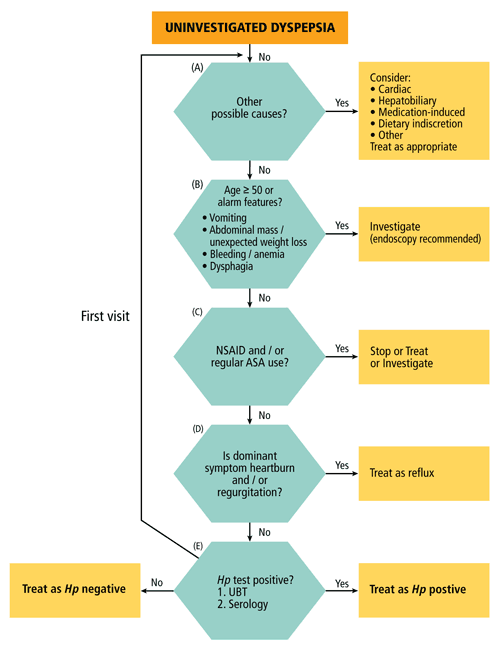
In the diagnosis of uninvestigated dyspepsia, UBT is preferred over other diagnostic tests for its accuracy, non-invasiveness and simple administration. According to the Canadian Association of Gastroenterology (CAG), urea breath test (not serology) should be used for routine diagnosis of H. pylori infection. Comparison of serologic testing and UBT has shown the latter to be consistently superior for the diagnosis of H. pylori infection. Notably, serology cannot be used to determine cure, since it takes 6 – 12 months for the test to report negative once the infection has cleared. 1
 Download Brochure
EN | FR
Download Brochure
EN | FR
Testing Recommendations
Non-invasive methods are recommended for first line detection of H. pylori. UBT is the preferred method of testing, as it is non-invasive, easy to administer and highly accurate. Serology is generally endorsed as a second option diagnostic procedure 1.
Clinical Management Tool
Safety
Warnings and Precautions
- The following groups of medications may interfere with test results and should be discontinued for the following time periods prior to using Helikit® :
- Proton Pump Inhibitors (H+, K+-ATPase Inhibitor) – 3 days
- Histamine H2 Receptor Antagonists – 1 day
- Antibiotics – 4 weeks
- Bismuth preparations – 2 weeks
- Do not drink or eat for at least 4 hours before taking the test.
- Helikit® test should be scheduled prior to barium tests if both are scheduled for the same day.
- No other breath tests should be scheduled at the same time as Helikit®.
If particulate matter is visible in the reconstituted 13C-urea solution after thorough mixing, the solution should not be consumed.
Shelf Life and Storage :
Helikit® should be stored at 15°C to 30°C (59° to 86°F) and should not be used beyond its expiry date.
Age Criteria :
Helikit® has been validated in individuals aged 6 years and over.
Product Information
Download Helikit User GuidelinesPatient preparation
- Patients must have followed all of the warnings and precautions.
- Before beginning the test, provide the patient name and identification number on the green and yellow labels.
- Fill out the registration card and ensure that the information corresponds to the information on the labeled tubes.
Step 1: Collect the first breath sample into the green capped collection tube as follows:
- Remove screw cap from the collection tube;
- Take a normal breath. Then exhale fully for 4 seconds through a straw into the bottom of the collection tube. While exhaling, withdraw the straw. Do not exceed 8 seconds total;
- Immediately replace screw cap on the collection tube;
- Tighten until snug and affix completed green label to the tube.
Step 2: Prepare solution by adding tap water to fill line on the plastic container. Mix until completely dissolved and then drink. Do not drink or eat anything during 30 minutes.
Step 3: 30 minutes after drinking the solution, exhale fully into the yellow capped collection tube following the same directions as for the first sample (Step 1). Affix completed yellow label to the tube.
Step 4: Insert the two collection tubes into the mailing box, and return with the registration card to the testing facility for analysis.
Note: The breath test samples, if stored between 15°and 30°C (59°and 86°F), are stable up to 6 months from the collection date.
Useful Links
Clinical Validation of the Helikit® : A 13C Urea Breath Test Used for
the Diagnosis of Helicobacter Pylori Infection – http://www.ncbi.nlm.nih.gov/pubmed/10074893
CMAJ – An evidence-based approach to the management of uninvestigated dyspepsia in the era of Helicobater Pylori – http://www.cmaj.ca/cgi/reprint/162/12_suppl/s3
American Gastroenterological Association – http://www.gastro.org/
American Journal of Gastroenterology – http://www.gastrojournal.org/
New England Journal of Medicine – http://www.nejm.org/doi/full/10.1056/NEJMcp1001110?siteid=nejm&keytype=ref&ijkey=ztxuQxkNt71cw&
- Sander J.O. Veldhuyzen van Zanten, Nigel Flook, Naoki Chiba, David Armstrong, Alan Barkun, Marc Bradette, Alan Thomson, Ford Bursey, Patricia Blackshaw, Dawn Frail, Paul Sinclair, for the Canadian Dyspepsia Working Group. An evidence-based approach to the management of uninvestigated dyspepsia in the era of Helicobacter pylori. Canadian Dyspepsia Working
Group, CMAJ • JUNE 13, 2000; 162 (12 Suppl)